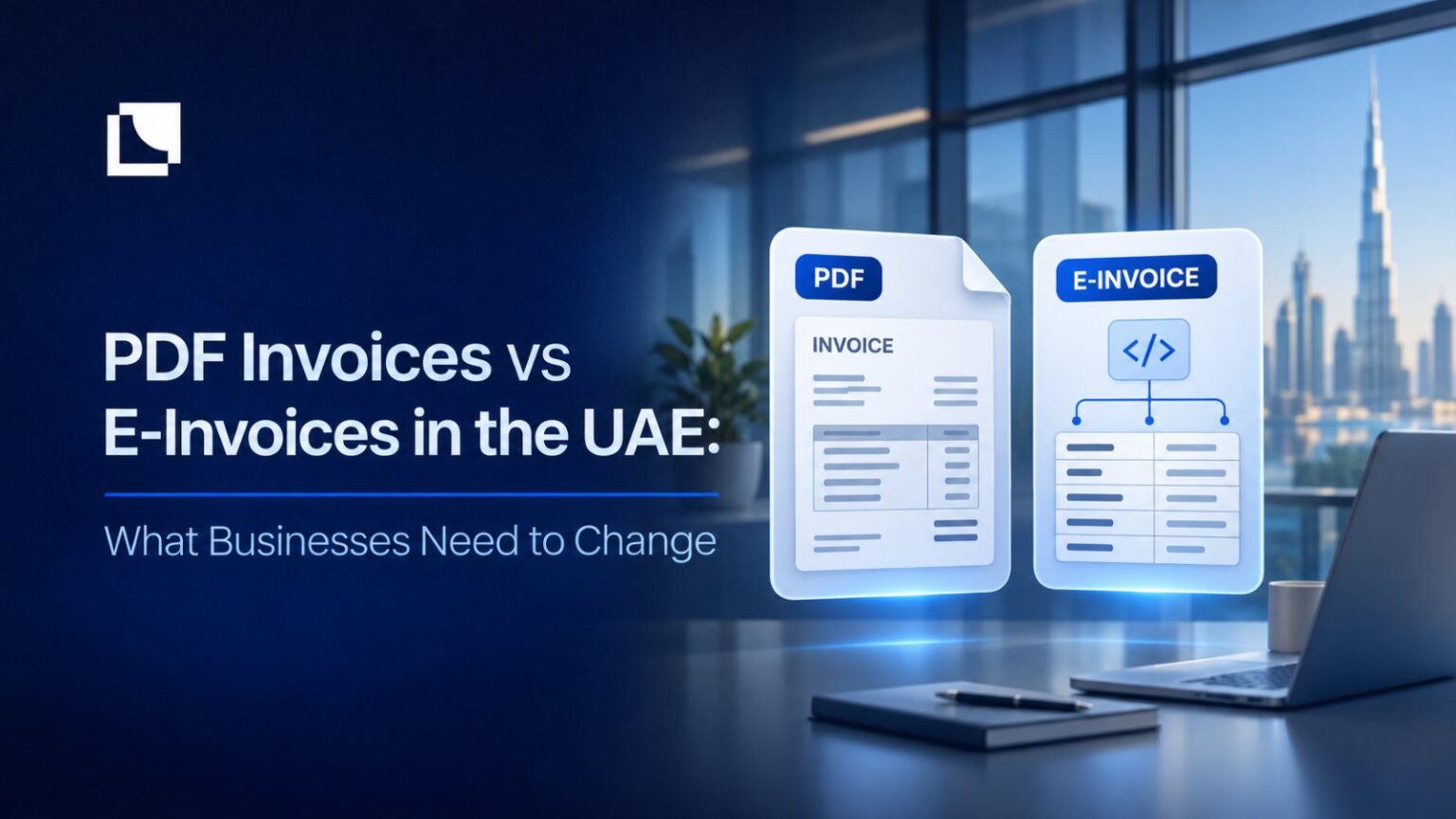
Many UAE businesses still prepare invoices in Excel, Word or accounting software, save them as PDFs and email them to customers. Under the UAE e-invoicing system, however, sending an invoice electronically is not the same as issuing an e-invoice.
When you compare PDF invoices vs e-invoices in UAE, the difference comes down to format. A PDF is a document designed for people to read. A structured e-invoice is data designed for systems to read, check and report. This article explains that difference, what official guidance says about PDFs and what your business needs to change before its implementation date.
What Is the Difference Between a PDF Invoice and an E-Invoice?
A traditional PDF invoice is a fixed-layout document. A business generates the details, exports the file and sends it by email or a file-sharing link. The customer reads it and often re-keys the supplier name, amounts and VAT into their own accounting system.
A structured electronic invoice holds the same information as separate data fields, such as the buyer’s details, line items, VAT and totals. In the UAE, it follows PINT AE, the UAE version of the international Peppol invoice standard. Peppol is a network that lets different systems exchange invoices in a common format.
Instead of travelling by email, the e-invoice passes through Accredited Service Providers (ASPs), the companies officially accredited to connect businesses to the e-invoicing network. The supplier’s ASP validates the data, converts it into the UAE’s standard XML format where needed and sends it to the buyer’s ASP, which delivers it to the buyer.
Tax data from the invoice is reported to the Federal Tax Authority (FTA) along the way. This is why a PDF attachment, even one created by accounting software, is not automatically a structured e-invoice.
| PDF Invoice | Structured E-Invoice |
|---|---|
| Shared as a document | Exchanged as structured data |
| Often requires manual data entry | Supports automated data processing |
| Information must be read or extracted from the file | Designed for machine-readable processing |
| Usually sent by email or file sharing | Exchanged through ASPs on the UAE e-invoicing network |
| Not considered a structured UAE e-invoice | Built to the UAE technical specification (PINT AE) |
Are PDF Invoices Accepted Under UAE E-Invoicing Rules?
For transactions within scope, no. The Ministry of Finance’s e-invoicing guidance states that unstructured formats, including PDF and Word files, images, scanned copies and emails, are not e-invoices.
Emailing an invoice is sending it electronically, but UAE electronic invoicing compliance depends on issuing it as structured data through the official framework. A PDF or scanned invoice cannot meet that requirement on its own, however professional it looks.
PDFs do not disappear entirely. A readable copy can still help with customer communication, internal approvals or quick reference. Its role changes, though: the PDF becomes a convenience copy, while the structured e-invoice exchanged through the ASPs is the record that counts.
Businesses must also keep their electronic invoices and related data for the period set by the Tax Procedures Law. Follow the latest FTA e-invoicing guidance as the rules develop.
What Changes Do UAE Businesses Need to Make?
Moving away from PDFs is less about how your invoice looks and more about how invoice data is created, sent and checked.
- Review the current invoicing process: Map where invoices start today, whether in Excel, a Word template, a PDF generator or accounting software, and who edits them before they go out.
- Check invoice information: A PDF tolerates a missing field or an inconsistent customer name. Structured e-invoices are validated, so supplier, buyer, transaction and tax details must be complete and accurate.
- Choose a suitable e-invoicing solution: Check whether your accounting system can produce structured invoice data and connect to the framework through an ASP, directly or through an integration.
- Improve accounting processes: Record each invoice once instead of retyping it across files, and set a clear process for correcting and reissuing invoices that fail validation.
- Prepare employees: Finance teams will spend less time typing and more time reviewing data and handling exceptions, so train them before go-live.
- Review customer and supplier details: Keep business names and tax identification details accurate on both sides. You will also receive e-invoices from suppliers, so accounts payable needs to be ready, not just billing.
Does Your Business Need New E-Invoicing Software?
Not always, but basic invoice-generation software is not the same as an e-invoicing solution. Many tools can produce a professional PDF. Fewer can create structured invoice data, send it through an ASP and handle incoming e-invoices and rejections.
Accounting software remains central. It holds your customer records, invoice history, payments and VAT figures, and e-invoicing depends on that data being accurate. Typically, the accounting system connects to an ASP, which manages the exchange with your buyer’s ASP and the reporting to the FTA.
Before choosing e-invoicing software in UAE, check:
- Whether it generates structured e-invoices, not only PDFs.
- Which ASP it works with, and whether that provider appears on the Ministry of Finance’s list of accredited providers.
- How it handles incoming and rejected e-invoices.
- How it connects with your accounting records and VAT reporting.
- What support is available during setup and after go-live.
How Can Businesses Move from PDF Invoices to E-Invoices?
Here is how to switch to e-invoicing without disrupting billing:
- Review existing invoice formats and accounting systems, including manual workarounds.
- Identify your implementation requirements and deadline. Our UAE e-invoicing readiness checklist sets out the phases.
- Check business, customer and supplier information.
- Select an Accredited Service Provider that works with your accounting system.
- Configure your accounting and invoicing system to produce structured invoice data.
- Test invoice creation, transmission and validation, including credit notes and corrections.
- Train the finance team, then monitor rejections and fix recurring data issues.
How LedgerPlus Helps Businesses Manage Invoicing and Accounting
LedgerPlus provides accounting and financial management solutions for UAE businesses, bringing invoicing, bookkeeping and reporting into one place. Invoice management sits alongside professional accounting services for businesses, so billing records flow into your accounts.
The platform also supports VAT compliance services in the UAE and Corporate Tax work, along with business expense management and clearer visibility of your finances. Depending on your package, an accountant or account manager supports your accounting work.
For structured invoicing, LedgerPlus offers an e-invoicing application that works with an accredited service provider. Review its UAE e-invoicing software and requirements and confirm with the team which features your plan includes.
Conclusion
When it comes to PDF invoices vs e-invoices in UAE, a PDF is still a useful document, but it is not a structured e-invoice under the UAE framework. Businesses that rely on emailing PDFs will need to change how invoice data is created, checked, exchanged and stored.
Review your current invoicing and accounting systems well before your implementation deadline, so there is time to fix data gaps, choose a provider and test the new process.
Not sure whether your current invoicing system is ready for UAE e-invoicing requirements? LedgerPlus can help you manage your accounting, invoicing and tax compliance processes with professional support. Contact our team today to discuss the right solution for your business.
Frequently Asked Questions
Is a PDF invoice considered an e-invoice in the UAE?
No. A PDF is an unstructured document. A UAE e-invoice is structured data in the UAE format, exchanged through accredited service providers and reported to the FTA.
Can businesses continue sending PDF invoices to customers?
They can share a PDF as a readable copy. For transactions within scope, however, it does not replace the structured e-invoice issued through the e-invoicing framework.
What is the main difference between PDF and structured electronic invoices?
A PDF presents invoice details for people to read. A structured electronic invoice stores each detail as data that systems can validate, exchange and process automatically.
Do small businesses in the UAE need e-invoicing software?
Many will, because the requirements are phased in by revenue rather than applying only to large companies. Check whether your transactions are in scope, your implementation date and whether your current software can meet the requirements.
How can a business prepare for UAE e-invoicing?
Review your accounting system, clean up invoice and customer data, choose an accredited service provider and train your finance team before your go-live date.